• Subscribe by e-mail

    Enter your email address:

    Delivered by FeedBurner

  • Connect

  • Archives

  • Categories

Training: A Solution Looking for a Problem

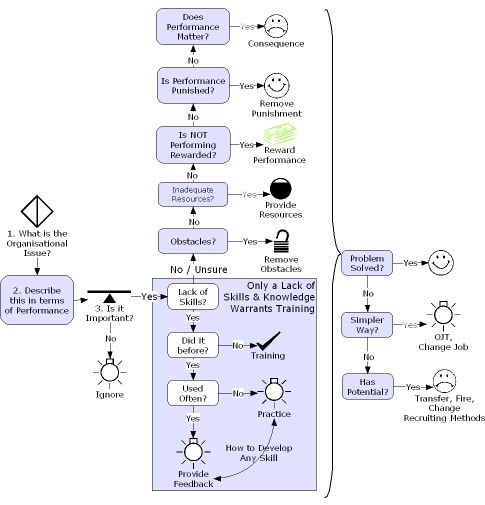
While listening to the radio the other day, the person being interviewed spoke about the need for training for those responsible for ensuring clean water in many remote Canadian communities. Now, I’m not going to say that training is not required, but making the leap from a performance issue (lack of skills, abilities, knowledge; lack of access to appropriate data and resources; etc) directly to training as the only solution, is the wrong approach and the most costly. As a taxpayer, I don’t want government to slap training bandaids on any problem that involves work performance. Some barriers to performance that are often overlooked when prescribing training include:

  • Unclear expectations (such as policies & guidelines);
  • Inadequate resources;
  • Unclear performance measures;
  • Rewards and consequences not directly linked to the desired performance.

In some cases, these barriers could be addressed and there would be no further requirement for training. Where there is a genuine lack of skills and knowledge, training may be required, but it should only be in cases where the other barriers to performance have been addressed. A trained worker, without the right resources and with unclear expectations, will still not perform up to the desired standard, and the drinking water supply may still be in danger.

I have noticed that many large organisations have this tendency to slap on the training bandaid once any issue has been labelled a human performance issue. Training that is not directly related to performance wastes time, bores workers and costs money. Here is a general diagram of the high level process of performance analysis, and here is another showing several of the barriers to performance. These posts, and the diagrams, are Creative Commons licensed, so go ahead and use them. You might even save some money.
* Content from jarche.com is protected under a Creative Commons Attribution-NonCommercial License

6 Responses to “Training: A Solution Looking for a Problem”

  1. [...] So, are these methodologies suitable for today? The short answer is yes, but not everywhere. Too often we see training as a solution looking for a problem. Training often worked before, or at least didn’t create more problems, when work processes and organisations were stable. As we move to more networked businesses, training’s weaknesses are becoming evident. These weaknesses are also evident when we don’t really know what the performance objectives are in a constantly evolving society, economy and marketplace. [...]

  2. [...] is not the first, nor the second, but the third time that I have heard our national broadcaster report the unfounded notion that [...]

  3. [...] I’m currently working on a project that requires me to get back to some performance and training analysis. Of course, my initial outlook is that training can often be a problem looking for a solution. [...]

  4. [...] to Performance Improvement to Steve, as it helps get training departments out of the “solution looking for a problem” approach. As much as books like this are a good start, a shift to performance improvement is [...]

  5. [...] I think of HPT (human performance technology) as an enabler to get to first base in instructional systems design (ISD). Without the proper analysis of the organizational needs, constraints and performance factors, a “learning” project may be doomed from the onset, because too often, training is a solution looking for a problem. [...]

  6. [...] years ago, I wrote in Training: A solution looking for a problem, that some barriers to performance which are often overlooked when prescribing training, [...]

Leave a Reply

Spam Protection by WP-SpamFree