Stephen Downes took me to task for my suggestion that collaboration was the optimum type of group work in networks:
collaboration means ‘working together’. That’s why you see it in market economies. markets are based on quantity and mass.
cooperation means ’sharing’. That’s why you see it in networks. In networks, the nature of the connection is important; it is not simply about quantity and mass …
You and I are in a network – but we do not collaborate (we do not align ourselves to the same goal, subscribe to the same vision statement, etc), we *cooperate*
I began to see that co-operation makes more sense as the term to describe working together in a networked and non-directed relationship. So is the distinction important? I think so. Jérôme Delacroix provides another confirmatory post on “co-operation” as the suitable term for what we do in networks [in French]. Jérôme explains why his site is called Cooperatique and not Collaboratique – collaboration happens around some kind of plan or structure, while co-operation presumes the freedom of individuals to join and participate. He also says that co-operation, not collaboration, is a driver of creativity. That’s quite an important distinction when looking at work analysis and design.
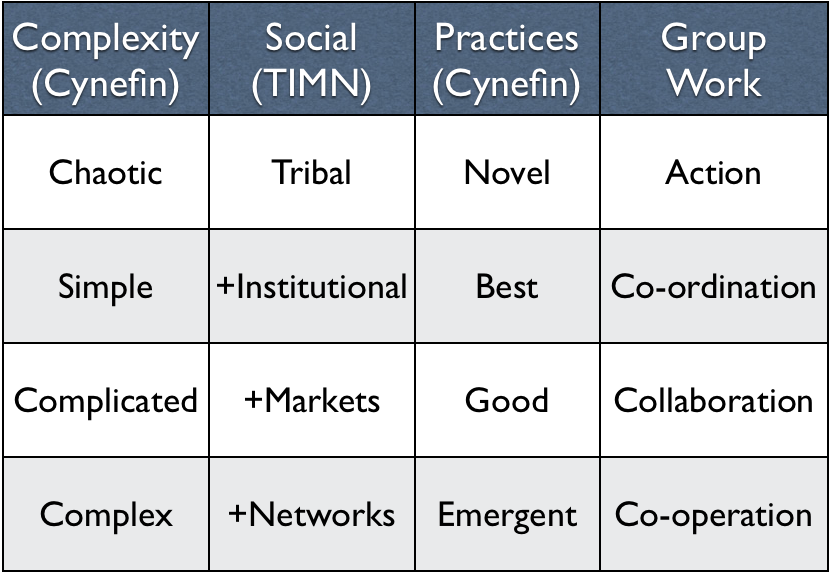
Here is my revised table, for the record:
I must disagree with this hierarchy of cooperation and collaboration.
Take YouTube, Flickr, etc… people there share, but do not create a common object, so indeed they cooperate. But because of that, they have weak links and can’t operate their own platforms.
On the other hand, take Firefox plug-ins, Linux, Wikipedia etc.. People are clearly working together, they are peer producing operating systems, browsers, universal encyclopedias; They have stronger links and therefore are able to run their own infrastructures.
To my understanding, this type of working together is therefore stronger, more efficient, more productive and therefore holarchically more encompassing.
You can collaborate and cooperate because the former includes the latter (peer production is based on freely contributing), but you can’t cooperate/shared and also having collaboratively created a common artefact.
Michel
Good points Michel and thanks for commenting. I still think that co-operation is what happens in networks and collaboration is the type of group work done in a market. Developing an open source project is a kind of market (for services, for recognition and sometimes for money) where people collaborate, but most likely they met or heard of each other through one of their co-operative networks like the open source community. That’s my take on operationalizing these concepts.