Copyright - a model for a previous era?

I’ve been reading the OpenBusiness blog for a while, trying to get a handle on copyright, which I’ve previously described as being important for our society and our economy. This article, via OpenBusiness, in The Times, is a good start in describing the big issues:
Economists tell us that, as the marginal costs of reproduction shrink, [...]

Life as a Free Agent

I read Dan Pink’s Free Agent Nation just before I started working for myself and would recommend it to anyone else looking at making the leap to freelancing.
After almost three years, here’s a partial list of what being a free agent means to me:

10. Doing my own tech support
9. Only working seven days a week
8. [...]

Aliant Highspeed and NetAssistant

About six months ago I wrote about the difference between advertised and actual Internet connection speeds from my service provider, Aliant (a Bell Canada company). This post gets quite a few hits so I checked the links to make sure that they’re up to date.
I found that Aliant’s speed check is no longer web-based and [...]

UK ’s JISC Recommends Open Source in Higher Education

The Joint Information Systems Committee (JISC), which represents higher education institutions in the UK, has released a briefing paper that strongly supports open source software for education. JISC’s Development Director stated:
JISC sees open source software as an important component in developing a sustainable ICT infrastructure for UK higher and further education. This briefing paper sets [...]

Jury Duty 2006

Just received a summons for jury duty today. Not sure if I should be pleased to be doing my civic duty or perturbed that I’m going to be missing five days of work. I’m not a dentist, lawyer, veterinarian etc., so I’m not officially ineligible to serve as a juror. As a self-employed consultant, five [...]

Quotable Comments on Learning

Here is a random selection of some quotes that I’ve been collecting. This collection is one example of why I focus my efforts on informal learning rather than more formalised education.
“… curriculum is a solution to a problem we created.” Brian Alger
“No generation in history has ever been so thoroughly prepared for the industrial [...]

Training: A Solution Looking for a Problem

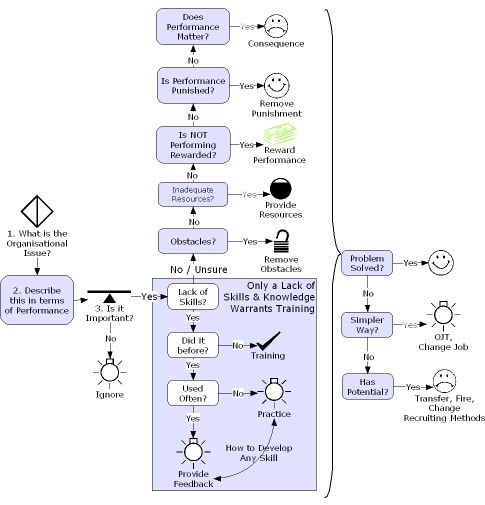
In listening to the radio the other day, the person being interviewed spoke about the need for training for those responsible for ensuring clean water in many remote Canadian communities. Now, I’m not going to say that training is not required, but making the leap from a performance issue (lack of skills, abilities, knowledge; lack of access to appropriate data and resources; etc) directly to training as the only solution, is the wrong approach and the most costly. As a taxpayer, I don’t want government to slap training bandaids on any problem that involves work performance. Some barriers to performance that are often overlooked when prescribing training include:

  • Unclear expectations (such as policies & guidelines);
  • Inadequate resources;
  • Unclear performance measures;
  • Rewards and consequences not directly linked to the desired performance.

In some cases, these barriers could be addressed and there would be no further requirement for training. Where there is a genuine lack of skills and knowledge, training may be required, but it should only be in cases where the other barriers to performance have been addressed. A trained worker, without the right resources and with unclear expectations, will still not perform up to the desired standard, and the drinking water supply may still be in danger.

I have noticed that many large organisations have this tendency to slap on the training bandaid once any issue has been labelled a human performance issue. Training that is not directly related to performance wastes time, bores workers and costs money. Here is a general diagram of the high level process of performance analysis, and here is another showing several of the barriers to performance. These posts, and the diagrams, are Creative Commons licensed, so go ahead and use them. You might even save some money.

Dave’s Social Media Project

Dave Cormier has started a wiki with the provisional title; The Best Damn New Media Curriculum Evah! Plan. The idea is to get a number of thinkers and workers together to build something (a course?) that will support and encourage learning activities on the Web. I’ve volunteered to get involved and we’ll see where this all goes.

I like the idea of a collaborative curriculum, but I have some concerns about the restrictive aspects of curriculum, as has been brilliantly described by Brian Alger. My own focus will be to try to develop some artifacts that could be used by others to support learning in an inter-networked world. Nothing ventured, nothing gained; so it’s time to stick out our necks and create something new. Check it out and join us.

2nd Anniversary

Many bloggers reflected on what they had learned on the arrival of the new year. I’m doing it now because 1) I have some time as I sit in a Montreal hotel hoping that the freezing rain won’t cancel my flight home and 2) the second anniversary of this blog is on Sunday, the 19th, but I’d rather not turn on my computer this weekend, after two weeks away from home.

On reflection, I can confirm how powerful informal learning is becoming, in a ubiquitously connected & pervasively proximate, world. Many people are using their expanded networks to learn and collaborate. On the other side, there is still a large segment of the population trapped in hierarchial organisations where information, knowledge and decisions trickle through layers of filtration. I’ve also realised that the digital divide, or digital immigrants vs digital natives, is not generational, it is attitudinal. As a baby boomer, I thought that my generation was way behind younger generations. However, I have met many university-educated people, 20 years younger than me who don’t have a clue about the basic operations of computers and the Internet. Even school-age children don’t have basic information search capabilities, and many do not understand how to evaluate a source of information. We have a long way to go in becoming a society of autonomous knowledge workers.

On a positive note, I’m excited about being part of Education Bridges and I’ve seen some real progress in extending our research and education network at the Atlantic Wildlife Institute, where I volunteer as the Director of Education. These grassroots projects are stimulating, even though they don’t pay the bills.

I’m also finding that this year I have not had to go out and market my services. All of my projects to date have been referrals and I believe that this is partly due to my blog. I continue to promote blogging for free-agents, and those considering going out on their own, as the most effective marketing tool there is.

So I guess it’s one more year of interesting conversations for me …

Moodle now in the major league

I received a mass mailing from HorizonWimba today about their Genie "course authoring tool" which imports content from Word. Usually I dump this stuff from vendors, as I prefer customer reviews, not marketing information; but this caught my interest:

This new version most notably features the ability for instructors to create Flashcards, insert code such as HTML and Java, and export their course content to new Blackboard, WebCT, and SCORM formats (ideal for Moodle users).  Course Genie allows faculty to quickly and easily convert their Microsoft Word documents into content for their Blackboard, WebCT, Moodle, and other online courses.


This is the first time that I’ve seen proprietary elearning companies selling to those who use open source. It shows that Moodle users are now in the same league as WebCT & Blackboard users, at least from a third-party vendor’s perspective.

Creative Commons License
This work is licensed under a Creative Commons Attribution 2.5 License.